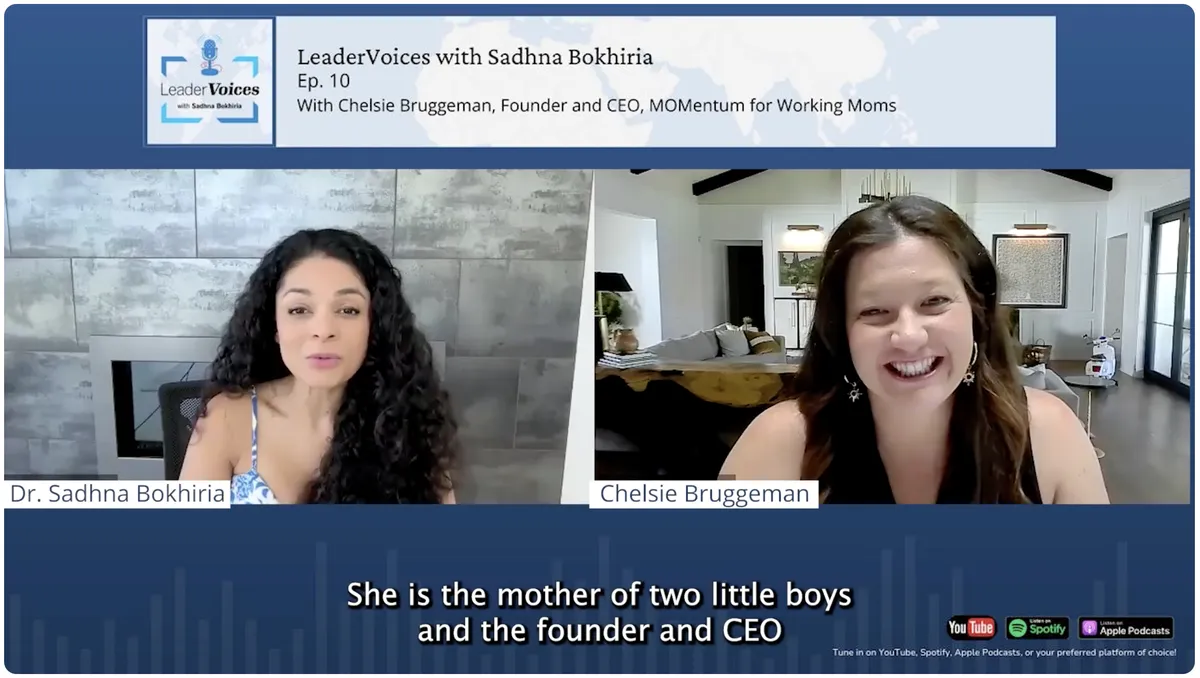
MOMentum Featured on "LeaderVoices" Podcast
It was such an honor to sit down with Dr. Dr. Sadhna Bokhiria on the Leader Voices podcast to talk about the heartbeat of MOMentum. We dove deep into the identity shifts that happen when we become mothers, the reality of "matrescence," and why I believe motherhood isn't a detour from leadership—it’s the refining ground for it.
If you’ve ever felt the tension between your career and your home life, this conversation is for you. You can listen to the full episode below or read the transcript to dive into our discussion on how we can reshape corporate culture in Arizona and beyond.
Podcast Highlights: The MOMentum Factor
1. Embracing Matrescence
We often talk about adolescence, but we rarely name matrescence—the profound physical, emotional, and identity transition into motherhood. It is as volatile and significant as any other major life stage, and it requires a complete renegotiation of who we are at work, with our partners, and within ourselves.
2. Integration over Compartmentalization
The "traditional" leadership path often asks women to hide their motherhood to be taken seriously. At MOMentum, we advocate for integration. We don’t want to "lean in harder" to a system that wasn't built for us; we want to build a new container that treats motherhood as an accelerator for leadership skills like empathy, resilience, and strategic prioritization.
3. Ambition Without Apology
Working moms don't lack ambition; they lack support designed for their reality. We discussed the importance of advocating for flexibility—not as a "favor," but as a performance strategy that allows us to contribute at our highest level while honoring our capacity.
Full Transcript: Leader Voices with Chelsie Bruggeman
Dr. Sadhna Bokhiria: Hi, I'm Dr. Sadhna Bokhiria, and this is Leader Voices—a show about leaders and their infinite ability to change the world. Each episode, we dig into stories and sparks from purpose-driven leaders, coaches, and everyday heroes. Today, I am super excited to invite Chelsie Bruggeman. She’s the mother of two little boys and the founder and CEO of an incredible organization called MOMentum.
Chelsie is not only the CEO of this incredible organization, but she’s also a "rainmaker" in the fundraising sector, having raised over $15 million for Arizona State University alone. She was also recognized in the Phoenix Business Journal’s exclusive 40 Under 40 club. Through MOMentum, Chelsie fosters community resources and professional development to enhance mothers' economic security during what we call "matrescence." Please join me in welcoming Chelsie to Leader Voices!
Chelsie Bruggeman: Yay! Thank you so much, Sna. You are so wonderful, and I’m so grateful to be here.
Dr. Sadhna Bokhiria: We’re so excited to have you! Tell me, just start from the beginning—what got you into higher ed and fundraising?
Chelsie Bruggeman: I think we share that "overachiever" quality! Higher ed was a place where I thrived. I loved the "gold stars"—that external validation. I have three degrees from ASU and got my first job there managing scholarship programs. I learned early on that the world works when you simply ask for things—and that philanthropy has the power to change lives. I stayed in higher ed for 12 years because they kept putting goals in front of me that I could achieve.
Dr. Sadhna Bokhiria:What’s interesting is that you’re an entrepreneur, but even in your career, you were essentially an entrepreneur because your position was often tied to the funding you raised. How does that connect to your mindset?
Chelsie Bruggeman: In fundraising, you’re selling the idea of changing lives and economic impact, but really, you're selling trust. My number one superpower is building trust. I care about people deeply. It’s about figuring out what someone wants to accomplish in the world and showing them how they can make it happen.
Dr. Sadhna Bokhiria: Tell me more about MOMentum. The idea is so innovative, and yet it makes perfect sense.
Chelsie Bruggeman: I’m so excited about this. Seven years ago, when my first son was born, the goals I had set for myself and the focus on my career dissipated. I actually left my maternity leave early because I felt so insecure and incompetent as a mother. I knew how to be an employee, but I didn't know how to be a mom.
Then, my second son was born in May 2020. I was isolated, scared, and felt like every decision—even ordering takeout—was life or death. I realized that even with every privilege—white, educated, upper-middle-class, with active grandparents—this was the hardest thing I had ever done. I kept thinking, “What are other mothers doing? How are single moms doing this?”
That’s where MOMentum was built. I wanted to create a community of working moms who understood each other. We’re not here to just give advice—we’re here to build professional and personal development tools so you can be the best version of yourself, holistically.
Dr. Sadhna Bokhiria: You have two young kids and you launched a company. How do you find balance?
Chelsie Bruggeman: I don't have balance. What I have is intentional imbalance. Some days I have to give everything to my job because that fuels me and makes me a better role model for my kids. Some days I miss the baseball game, and that’s painful. But then there are other days where I leave at 3:00 PM, pick them up for ice cream, and don't look at my phone for the rest of the night. It’s about standing in your values and showing your children how to contribute to society in a meaningful way.
Dr. Sadhna Bokhiria: I relate to that "fight or flight" feeling in the early years. What specific support do you suggest for mental health during those first five years?
Chelsie Bruggeman: I’ve been there—I suffered from extreme postpartum depression, largely due to a lack of sleep. My goal at MOMentum isn’t to tell moms what to do. I believe moms are capable, resourceful, and whole. My job is to sit with them, acknowledge how hard it is, and help them find the strategies that work for them.
We have to advocate for ourselves. We have to tell our employers the truth about what we need to stay in the workforce. One in five women leave the workforce after having their first baby. That is a massive loss of talent and economic security. I want to support businesses in understanding matrescence—this physical and emotional transition that is as volatile as adolescence.
Dr. Sadhna Bokhiria: I love that comparison to adolescence. It really is a "coming of age" where there is no going back.
Chelsie Bruggeman: Exactly. It’s a renegotiation with your identity, your partner, your body, and your time. I had to mourn the "Chelsea" that existed before kids to embrace who I am today.
Dr. Sadhna Bokhiria: What specific policies or advocacy efforts are you involved in?
Chelsie Bruggeman: We’ve seen a shift toward paid maternity leave and breastfeeding rooms, which is great. But I’m worried about the shift away from hybrid work. For a working mom, a hybrid schedule isn't about "slacking off." It allows us to manage the domestic load that statistically falls on women, so that our weekends can actually be restful rather than a second shift of chores.
It comes down to respect and autonomy. I shouldn't have to "ask" to leave at 3:30 for a school play if I am getting my job done. We need more moms in leadership roles because they are the ones who will make these policies.
Dr. Sadhna Bokhiria: How can we follow your work?
Chelsie Bruggeman: You can find me at momentumforworkingmoms.com. I’m always open to coffee or virtual meetings to build custom experiences for mothers and organizations. You can also find me on Instagram at @workinglikeamother, where I share the "external journal" of how hard and rewarding this journey is.
Dr. Sadhna Bokhiria: Thank you, Chelsie. You are the future, and you are changing it.
Chelsie Bruggeman: Thank you, Sadhna. Keep it up, Mama!